
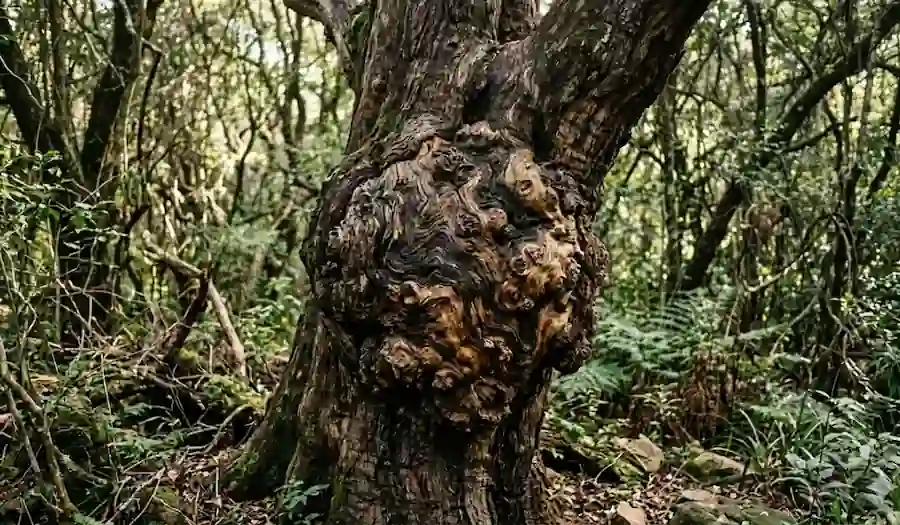
Burl Wood Definition and Characteristics
What is burl wood? Burl wood forms through abnormal tree growth, creating dense, irregular grain patterns that are highly valued for decorative and craft applications.
Unlike straight-grain timber, burl develops when a tree experiences stress, damage, or environmental disruption, causing the grain to grow in unpredictable directions.
This irregular growth produces complex internal structures and highly figured material, often used for its visual character rather than structural strength. Understanding what is burl wood and its meaning helps explain why these formations are highly valued.
Each documented piece can be traced through the Specimen Registry, linking individual material to its harvest and origin.
Learn how burl specimens are documented in the harvest archive.
What Is Burl Wood? Definition and Meaning
What is burl wood? Burl wood refers to timber produced from abnormal tree growth formations, where grain direction becomes distorted and compressed into swirling and interwoven patterns that differ significantly from standard timber.
The burlwood meaning comes from this irregular development, where trees respond to stress by producing dense, chaotic grain structures that create unique visual patterns within the wood.
How Burl Wood Forms
Burl formation occurs when a tree undergoes stress such as injury, fungal infection, insect activity, or environmental pressure. In response, the tree produces rapid and disorganised cell growth, leading to the formation of a burl.
As the burl develops, grain direction becomes irregular, creating the complex internal structure revealed when the wood is cut.
Burl Wood Grain Structure
The grain found in burl wood is highly irregular, containing interwoven fibres, dense figure, and non-linear growth patterns. This creates a visual structure that varies significantly across each section.
These characteristics often include natural voids, figure variation, and features such as insect markings or mineral lines depending on growth conditions.
How Burl Wood Is Used
Burl wood is primarily used in decorative and artistic applications where grain structure and natural form are central to the finished piece.
- Resin and epoxy work
- Decorative boards and wall pieces
- Furniture accents
- Woodturning and craft projects
Due to internal stress and irregular grain direction, stabilisation may be required depending on the intended application.
Why Burl Wood Is Valuable
Burl wood is highly valued for its unique grain structure and natural variation. Unlike standard timber, each burl develops under specific environmental conditions, meaning no two pieces are identical.
The combination of dense figure, irregular grain flow, and natural features such as voids or inclusions makes burl wood particularly desirable for decorative applications and creative woodworking projects.
Because each burl develops under unique environmental conditions, the resulting wood is inherently non-uniform. This makes burl wood particularly suitable for applications where individuality and natural variation are valued over uniformity, reinforcing its role as a material defined by origin rather than standardisation.
From Tree Growth to Finished Burl Wood
Understanding what is burl wood requires seeing how it transitions from natural growth to usable material. In its natural state, a burl forms on a living tree as a dense, irregular mass.
Once harvested, this section can be cut into slices, slabs, or blocks, revealing the internal grain structure that defines burl wood.
Within the BurlBlade archive, this process is documented from tree to specimen, linking natural formation to finished material.
Burl Wood in the BurlBlade Archive
Within the BurlBlade timber archive, burl wood is documented as part of a structured provenance system where each specimen is linked to its harvest origin and species classification.
Examples include the plum burl live edge slice PB2601003 and the PB2601 plum burl harvest.
Species-level characteristics can be explored through documentation such as the plum wood (Prunus).
Additional technical reference can be found at
The Wood Database (external reference)