
If you are looking for wood for resin art in South Africa, the material you choose determines everything — how the resin bonds, how voids fill, whether the finished piece holds or moves. BurlBlade supplies urban salvaged wood slabs and specimens from Gauteng, documented from harvest to sale, field seasoned, and selected specifically for epoxy resin compatibility. One of a kind. Cannot be restocked once sold.
The material you choose determines everything. Moisture content, grain structure, and void character are not variables you can correct after the resin is poured.
What makes good wood for epoxy resin projects?
The best wood for resin art has three qualities: low moisture content, stable grain structure, and interesting voids or natural defects that the resin can fill and highlight.
Moisture content is the most critical variable. Wood above 12% moisture will cause epoxy to cloud, overheat, or delaminate over time. For deep pour river table work, target 8% to 10% measured at multiple points across the slab — not just the surface. A single centre reading on a thick slab can look acceptable while the core is still wet.
Voids, cracks, borer beetle galleries, and natural inclusions are not defects in resin work — they are the feature. Urban salvaged timber from Gauteng carries these characteristics naturally from its growth environment. A plum burl grown in a suburban garden develops irregular grain, pockets, and tension lines that plantation timber never produces.
| Moisture Content | What it means for resin work |
|---|---|
| Under 8% | Very dry. Suitable for resin, furniture, turning. May need acclimatisation in humid environments. |
| 8–12% | Target range for resin encapsulation and river table work in South African workshop conditions. BurlBlade specimens ship within this range. |
| 12–15% | Borderline. Acceptable for furniture and structural work. Risky for full encapsulation resin pours. |
| Above 15% | Do not pour resin. The wood is still actively releasing moisture. |
⚠ Avoid species with high tannin or silica content for first projects — these can interfere with epoxy cure and cause discolouration. Softwoods like pine compress under resin weight in thick pours and are not recommended for structural river table work.
Which South African wood species work best for resin tables and art?
Plum burl — urban salvaged Gauteng
Plum burl is one of the most resin-compatible species available from urban salvaged sources in South Africa. The burl grain is irregular and dense, voids fill cleanly, and the warm pink-to-amber heartwood colour contrasts dramatically with clear or tinted resin. Field seasoned plum burl at correct moisture levels bonds reliably and does not off-gas significantly during cure.
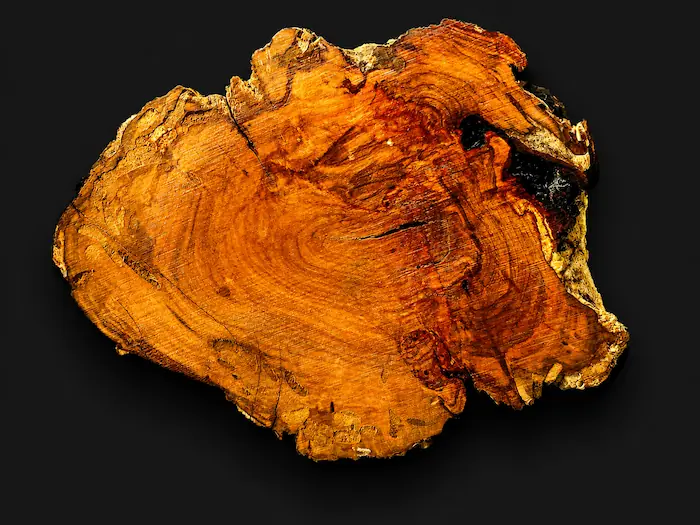
Ground stump root sections — urban salvaged Edenvale
Root sections cut from ground level carry void formations, channel structures, and radial grain patterns that are exceptional for statement resin pours. The geometry is unrepeatable — no two root sections from the same tree are identical. These are not suitable for beginners working without a moisture meter, as root sections retain moisture unevenly across their cross-section.
📏 PB2601 plum burl (Sunnyridge, Germiston — harvested January 2026): 8–10% MC across heartwood and sapwood by 1 March 2026. GS2602 grey searsia root sections (Edenvale — harvested February 2026): 10–12% MC on the same measurement date. Same seasoning process, two different species, two different results — which is why every batch is measured independently.
What to avoid for resin work
Species with high natural oil content — tamboti, wild olive — can inhibit epoxy cure at the surface. Freshly milled green timber of any species should never be used for resin projects regardless of how it looks or feels. Bark should always be removed before resin contact — bark fibres absorb resin unevenly and will cause delamination over time.
If you work with urban salvaged timber for resin projects and want to know when new documented specimens become available, join the BurlBlade archive list — we notify subscribers first, before specimens are listed publicly.
Where to buy urban salvaged wood slabs for resin art in Gauteng
BurlBlade is a timber provenance archive based in Germiston, Gauteng. Every specimen is urban salvaged — recovered from tree removals in residential Gauteng, not plantation grown or commercially milled.
Each piece is documented from the moment of harvest: species confirmed, harvest location recorded, milling date logged, moisture readings taken at multiple points. You know exactly what you are buying and where it came from. The exact item shown is the exact item shipped.
Available specimens are listed individually — each with wetted front photography, dimensional specifications, moisture content readings, and harvest origin. No generic stock. No restocking once sold.
“The unpredictability that makes urban timber less useful for joinery makes it more compelling for resin art.”
Wood for resin trays, boards, river tables, and art pieces
River tables
Thick slabs with natural live edges and central voids are the primary use case. Minimum 40mm thickness recommended for structural integrity after resin cure and surface levelling. Plum burl and root section slabs from BurlBlade are sized for river table work.
Resin trays and serving boards
Smaller cross-section pieces, cookies, and off-form slices work well for tray blanks. Wood cookies from urban salvaged plum show full annual ring detail when filled with clear resin — each ring visible as a distinct layer.
Casting blanks for jewellery and small art
Offcut cross-sections and small void-rich pieces are suitable for stabilising or partial casting. Borer beetle galleries in plum burl are particularly effective at this scale — the channels fill with resin and photograph dramatically.
Art panels and wall pieces
Live edge slabs mounted with resin river inlays or full flood coats. Flat, stable, correctly dried slabs are essential — any residual moisture will telegraph through a flood coat finish within weeks.
Continue reading
What is a Certificate of Provenance for Wood? — Every BurlBlade specimen ships with a documented provenance certificate. This post explains what it records, why it matters for resin artists, and how to verify it after purchase.
This article was researched and written with the assistance of AI tools. All facts, measurements, moisture content readings, harvest locations, and specimen data referenced are drawn from BurlBlade’s own documented archive and field records. The Provenance Method and all provenance claims represent real processes applied to real specimens.
Browse available urban salvaged specimens documented for resin work at burlblade.co.za/shop — every piece includes MC readings, wetted front photography, harvest location, and a provenance certificate.
Does the wood really need to be below 12% moisture before I pour resin?
Yes. Moisture above 12% causes epoxy to generate excess heat during cure, clouds the resin, and weakens the bond at the wood interface. For thick slabs over 50mm, target 8% to 10% and measure at multiple points — surface readings alone are not reliable. Urban salvaged field seasoned timber from BurlBlade is moisture-tested before sale.
Every PB2601 plum burl specimen harvested in Sunnyridge, Germiston in January 2026 measured 8–10% across heartwood and sapwood by 1 March 2026 — six weeks of indoor stacked field seasoning after milling. The GS2602 grey searsia root sections from Edenvale, milled two weeks later, measured 10–12% on the same date using the same method. Same seasoning process, same measurement date, two different species, two different results — which is exactly why you measure every batch independently rather than assuming a time formula is sufficient.
Should I remove the bark before applying resin?
Always remove bark before resin contact. Bark fibres absorb resin at a different rate to the heartwood beneath, creating a weak interface that will delaminate under temperature cycling. The live edge beneath the bark is the feature — the bark itself is not.
GS2602 root section specimens from Edenvale show bark that is partially loose on some pieces and firmly attached on others — sometimes on specimens from the same harvest session. Root bark behaves differently to stem bark because of the irregular growth pressure at ground level. On GS2602001 the bark was partially loose at inspection. On GS2602002 it was firm and intact. Treating all bark as stable because some pieces look solid will cost you a delamination failure.
Can I use wood with rot or soft spots in a resin project?
Surface rot can be stabilised with thin CA glue before resin contact if the structural integrity of the piece is sound beneath. Deep rot that affects the core of a slab is not suitable for structural resin work — the resin will fill the void but the surrounding fibre has no holding strength. Inspect by probing the suspected area firmly before committing to a pour.
PB2601004 presents a fused bark inclusion area with slight natural decay forming a small textured pocket — inspected March 2026, confirmed structurally stable with no twist or bow and moisture at 8–10%. That pocket is not rot in the structural sense. It is a surface feature. The distinction matters: decay that has stopped progressing in correctly seasoned timber behaves differently to active rot in green wood. PB2601004 is resin-ready. The same feature in freshly milled timber would not be
Is urban salvaged wood stable enough for a high-end resin project?
Urban salvaged timber that has been correctly field seasoned and moisture-tested is as stable as any commercially dried alternative — and frequently more interesting in grain and void character. The provenance documentation BurlBlade provides means you know the drying history, harvest date, and species confirmation before you buy. That is more information than most commercial timber suppliers provide.
PB2601008 is a natural fork plank — two organic limbs forming a central channel that is structurally unusual for any timber supply, urban or commercial. Inspected March 2026 at 8–10% moisture across both heartwood and sapwood, flat, no twist, no bow. That geometry does not come from a plantation. It comes from a tree growing in a Sunnyridge garden under its own conditions for decades. Stability is not compromised by origin — it is confirmed by measurement
Does urban wood react differently to epoxy than plantation timber?
Urban salvaged specimens grow under different stress conditions than plantation timber — irregular spacing, garden soil, proximity to structures. This produces denser grain, more tension lines, and more natural void formation than uniform plantation growth. These are advantages for resin work, not liabilities. The unpredictability that makes urban timber less useful for joinery makes it more compelling for resin art.
PB2601 borer beetle galleries are present in all nine specimens from the Sunnyridge harvest — confined primarily to the sapwood, with PB2601007 showing the most prominent gallery network across the grain. These galleries do not weaken the heartwood. They create void channels of consistent depth in the sapwood zone that fill with resin in a single pour without bridging. That specific combination — dense urban-grown plum heartwood with sapwood gallery channels — is not a characteristic of plantation Prunus grown under controlled conditions.
Where is the best place to buy wood for resin art in South Africa?
Current available specimens include urban salvaged plum burl from Sunnyridge, Germiston (PB2601 — nine specimens, harvested January 2026, field seasoned to 8–10% moisture) and grey searsia ground stump root sections from Edenvale, Gauteng (GS2602 — fourteen specimens, harvested February 2026, field seasoned to 10–12% moisture). Every piece is photographed wet, individually documented, and listed with its exact inspection notes. Browse available specimens at burlblade.co.za.
What is a timber provenance certificate?
A timber provenance certificate is a structured document recording the full chain of custody for a specific piece of wood. BurlBlade certificates record: harvest suburb (not just city — Sunnyridge or Edenvale, Gauteng), species confirmation, moisture content readings taken at multiple points across the slab on a specific date, cut type, milling date, and every ownership transfer since sale. The certificate is permanently assigned to that specimen — it cannot be transferred to a different piece of wood. Every BurlBlade specimen has a unique certificate ID in the format BB-[SpecimenID]-[OrderNumber]. See a live example for PB2601001.