
There are dozens of live edge wood slab suppliers in South Africa. Rare Woods, Country Woods, Timberstone, Kuhle Hardwoods, Leroy Merlin. Most have good stock. Some have excellent species selection. None of them will tell you the moisture content of the specific slab you’re buying, where exactly the tree was felled, or when it was harvested.
For a coffee table, that might not matter. For a resin river table, an epoxy countertop, or any application where the wood is encapsulated — it matters enormously.
A live edge slab is not a commodity. It’s a one-of-a-kind material — which is exactly why the information attached to it matters more than the species name or the price.
What is a live edge wood slab?
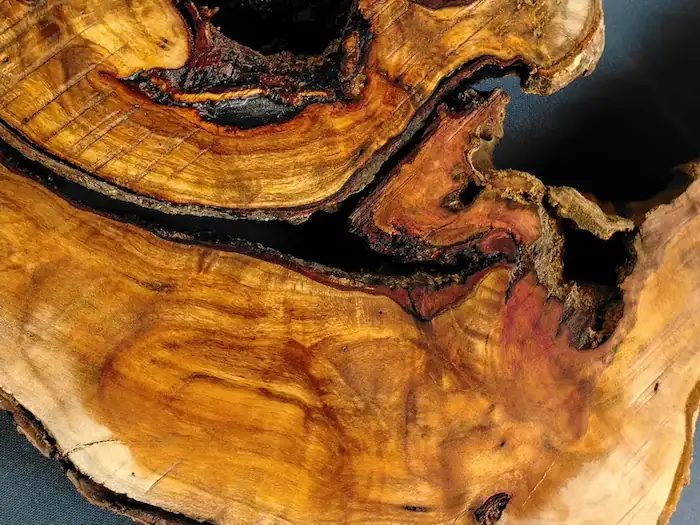
A live edge slab is cut from a log in a way that preserves the natural outer edge of the tree — the bark line, the irregularities, the character that a straight-edged board removes. The result is a piece that carries the shape of the tree it came from.
Live edge slabs are used for dining tables, coffee tables, bar tops, countertops, resin river tables, and decorative wall pieces. The natural edge is the feature — which means no two pieces are identical.
What most SA suppliers won’t tell you
Across the SA market — from warehouse operations in Gauteng to online retailers shipping nationally — the standard listing looks like this: species name, dimensions, price. Sometimes a photo. What’s missing from almost every listing is the data that actually determines whether the wood will perform.
| Missing from most listings | Why it matters |
|---|---|
| Moisture content | Wood above 12% MC will move, warp, crack, and delaminate — especially under resin. “Kiln dried” doesn’t say correct for what, or measured when. |
| Harvest date | Wood felled three years ago and properly seasoned is a fundamentally different material to wood felled three months ago. |
| Origin | “Locally sourced” covers plantation, municipal removal, or garden clearance. Growing conditions directly affect grain and structural behaviour. |
| Species confirmation | Some suppliers list generic “live edge slab” with species offered as a choice rather than a documented, traced record. |
Why this matters for resin work
If you’re sourcing a live edge slab for an epoxy river table or resin casting project, the documentation gap is a practical problem, not just an aesthetic one. Wood that hasn’t reached equilibrium MC will off-gas during the exothermic cure reaction — producing bubbles that have nothing to do with your mixing technique. Wood still moving after encapsulation will crack post-cure.
📏 Target before any resin pour: 8-10% MC. Field seasoned urban salvaged timber — dried slowly outdoors under cover, stickered flat, for six to twelve months minimum — reaches this range naturally and holds it.
A slab with unknown drying history is a variable you can’t control. You need to know the seasoning history to know what you’re actually working with — not what the listing assumes you’ll assume.
If documented provenance matters to your practice and you want to know when new field seasoned specimens become available, join the BurlBlade archive list — subscribers are notified before specimens are listed publicly.
What documented live edge looks like
Every specimen in the BurlBlade archive carries: species confirmation, urban salvage location to suburb level, harvest date, moisture content at time of documentation, verified dimensions, condition assessment, and inspection notes written from direct observation.
The plum burl specimens in the current archive were recovered from a residential removal in Sunnyridge, Germiston in January 2026. The ground stump root timber came from Edenvale, Gauteng in February 2026. Every piece is field seasoned, individually assessed, and listed only when the documentation is complete.
“A supplier who can answer the moisture content, origin, and harvest date clearly is worth buying from. A supplier who can’t is selling you a variable you can’t control.”
Live edge wood slabs for sale in South Africa — questions to ask first
- What is the moisture content of this specific piece — and when was it measured?
- Where was this tree felled — suburb and city, not just “locally sourced”?
- When was it harvested and how has it been stored since?
- Is this the exact piece I will receive, photographed individually?
A supplier who can answer all four clearly is worth buying from. A supplier who can’t — regardless of their species selection or pricing — is selling you a variable you can’t control.
Continue reading
Wood for Resin Art in South Africa — what makes wood resin-compatible, which species work best, and what to avoid for first projects.
This article was researched and written with the assistance of AI tools. All facts, measurements, moisture content readings, harvest locations, and specimen data referenced are drawn from BurlBlade’s own documented archive and field records. The Provenance Method and all provenance claims represent real processes applied to real specimens.
Browse documented live edge specimens — each with moisture content, harvest location, and a provenance certificate — at burlblade.co.za/shop.
What is the best live edge wood for resin tables in South Africa?
Dense hardwoods with low oil content perform best under epoxy resin. In the SA urban salvaged context, plum burl and ground stump root timber both bond well with resin. The species matters less than the moisture content — wood above 12% MC will cause adhesion failure regardless of species.
How much do live edge wood slabs cost in South Africa?
Prices vary significantly by size, species, and documentation. Small urban salvaged cookies start from around R37. Mid-range figured specimens typically fall between R400 and R1,500. Large boutique hardwood slabs from specialist mills can reach R15,000 and above. The wide range reflects differences in species, dimensions, and whether provenance documentation is included.
What moisture content should live edge wood be before a resin pour?
8-10% MC is the target range for resin encapsulation work. Wood above 12% will off-gas during cure, producing bubbles and potential adhesion failure. Always take multiple MC readings across the slab — edge, centre, and end grain — not a single spot measurement.
What is the difference between live edge and reclaimed wood?
Live edge refers to the natural outer edge of the slab being preserved. Reclaimed or salvaged wood refers to the sourcing method — timber recovered from demolition, tree removal, or salvage rather than plantation harvesting. A piece can be both — urban salvaged timber with the live edge preserved — which is what BurlBlade specialises in.
Where can I buy live edge wood slabs in Gauteng?
BurlBlade is based in Germiston, Gauteng, and sells urban salvaged wood specimens directly at burlblade.co.za. Every specimen is recovered from urban tree removals across Gauteng suburbs — the PB2601 batch was recovered from Sunnyridge, Germiston in January 2026, the GS2602 batch from Edenvale in February 2026. Both batches were field seasoned and measured at 8–12% MC using a pin meter on a sanded face before listing. Each specimen is a single unique piece — once sold it cannot be restocked. The full archive is at burlblade.co.za/shop.
This article was researched and written with the assistance of AI tools. All facts, measurements, moisture content readings, harvest locations, and specimen data referenced are drawn from BurlBlade’s own documented archive and field records. The Provenance Method and all provenance claims represent real processes applied to real specimens.

Marius Lamprecht is the founder of BurlBlade, a timber provenance archive based in Gauteng, South Africa. He recovers and documents urban salvaged wood specimens from tree to material — recording species, origin suburb, harvest date, and moisture content before listing each piece in the BurlBlade archive.