
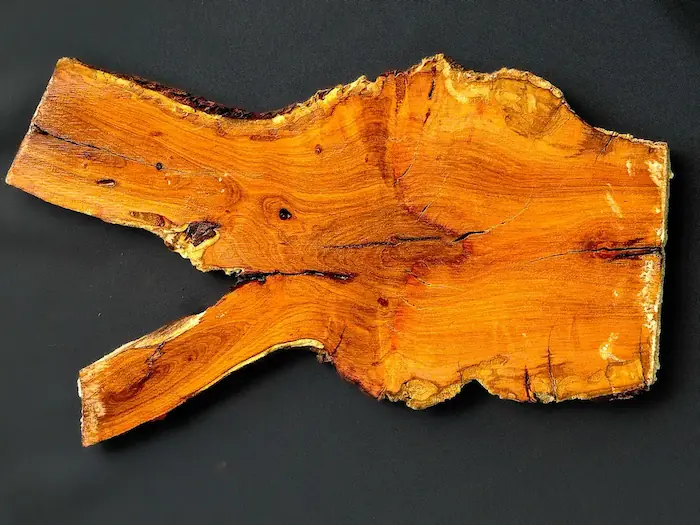
A live edge wood slab is cut from a log in a way that preserves the natural outer edge of the tree — the bark line, the curve, the irregularities that a straight-edged board removes. The live edge is not a style choice. It is what the tree actually looked like before the saw touched it.
Live edge slab wood has become the material of choice for makers, furniture designers, and resin artists who want a finished piece that carries provenance — not just grain, but a record of where the tree stood, how it grew, and what it survived. That information is either documented or it isn’t. Most of the time, it isn’t.
What is a live edge wood slab?
A live edge slab retains the natural profile of the outer tree — typically the sapwood layer and sometimes remnant bark along one or both edges. The cut is made parallel to the length of the log rather than squared off, which means the width varies naturally along the length of the piece.
The result is a slab with two distinct zones: the heartwood at the centre, typically darker and denser, and the sapwood toward the edge, lighter and often more figured. In urban salvaged specimens, borer beetle galleries, natural checking, and structural irregularities add a third layer of character that plantation timber simply doesn’t carry.
No two live edge slabs are the same. The edge profile, the grain direction, the figure — all of it is determined by how that specific tree grew in that specific location.
What types of wood are used for live edge slabs?
In South Africa the most common species used for live edge slabs are Kiaat, Yellowwood, Wild Olive, and imported Walnut and Oak. Each behaves differently in the workshop — density, movement, finishing response, and suitability for resin work all vary significantly by species.
Urban salvaged timber adds species that rarely appear in commercial supply: Plum Wood (Prunus), ground stump root timber, Camphor, and others removed from residential and municipal trees across Gauteng. These species are harvested once, documented at source, and do not reappear. The PB2601 harvest from Sunnyridge, Germiston yielded Plum Burl cookies and slabs cut in January 2026. The GS2602 harvest from Edenvale, Gauteng produced ground stump root timber in February 2026. Both are field seasoned and available as documented specimens.
For resin work specifically, density and void structure matter more than species name. A slab with natural voids, borer beetle galleries, or fork geometry gives resin somewhere to go — and the documented origin tells the maker exactly what they are working with before the pour starts.
How much does a live edge slab cost in South Africa?
Live edge slab prices in South Africa range from R200 for small cookies and off-cuts to R8,000 and above for large figured dining slabs. The price is determined by species, size, figure, and whether the piece is documented.
Urban salvaged specimens from a single-harvest archive sit at a different point in the market — not because of size, but because of provenance. A slab with a Certificate of Provenance, a documented MC reading, and a suburb-level harvest location carries information that a generic live edge slab from a timber yard does not.
For makers who sell finished work, that provenance transfers to the piece. The story of where the wood came from becomes part of what the buyer is purchasing.
Where can I buy live edge slabs in South Africa?
Timber yards, online marketplaces, and specialist suppliers all carry live edge slabs in South Africa. Rare Woods SA, KDA Furniture and Lumber, and Timberstone are established commercial suppliers with consistent stock across common species.
BurlBlade operates differently — as a timber provenance archive rather than a stocking supplier. Each specimen in the archive is urban salvaged, field seasoned, and documented individually. Stock is finite by design. When a harvest is sold through it does not restock — the specimens from that tree are gone.
Browse the current archive at burlblade.co.za/wood-specimens/ or view the full harvest records for PB2601 Plum Burl and GS2602 Ground Stump Root Timber.
How do you finish a live edge slab?
The finishing approach depends on the intended use. For furniture and display pieces, hardwax oils and penetrating finishes preserve the natural texture of the live edge without building a plastic surface layer. For resin work, the slab goes unfinished until after the pour — any surface treatment before casting can interfere with epoxy adhesion.
Regardless of finish, the surface preparation is the same: sand progressively through the grits, raise the grain with water, sand again, then apply finish to a clean dry surface. On live edge slab wood with bark inclusions or natural voids, a thin stabilising coat of CA glue before finishing will lock loose fibres and prevent them lifting under the finish.
The edge itself — the natural live edge profile — is typically left raw or treated with a clear penetrating oil to prevent checking over time.
What moisture content should a live edge slab be before a resin pour?
Below 12%. That is the widely cited threshold for deep pour epoxy work, and it holds in practice.
Above 12% moisture content, the wood continues to release water vapour during the epoxy cure cycle. The resin seals the surface before the moisture can escape. The result is bubbling, delamination, or a pour that appears to cure correctly and then fails over weeks.
The only way to know the MC of a slab before a pour is to measure it — with a pin meter on a sanded face, not a visual inspection. Surface readings and core readings are different numbers. The PB2601 Plum Burl specimens from Sunnyridge, Germiston measured 8–10% MC on a pin meter reading taken on a sanded face, documented March 2026. The GS2602 ground stump root timber from Edenvale, Gauteng measured 10–12%.
Both are within safe range for deep pour epoxy work. Both readings are on the product page and on the Certificate of Provenance that ships with every specimen.
If your supplier cannot give you a documented MC reading — not an estimate, not “it’s been drying for a while” — that is the gap provenance fills. Browse live edge slabs for sale in South Africa with documented MC readings at burlblade.co.za.
Common questions about live edge wood slabs
What species are available in urban salvaged live edge slabs from Gauteng?
The current BurlBlade archive includes Plum Wood (Prunus) from the PB2601 Sunnyridge, Germiston harvest and ground stump root timber from the GS2602 Edenvale harvest. Upcoming harvests include Pagoda, Cedar, Sweet Thorn, and Cottonwood — all urban salvaged from Gauteng and milled to order. These species do not appear in commercial timber supply because they come from single residential and municipal removals, not managed plantations.
What moisture content do BurlBlade live edge slabs ship at?
PB2601 Plum Burl specimens measured 8–10% MC on a pin meter reading taken on a sanded face, documented March 2026. GS2602 ground stump root timber measured 10–12%. Both are within safe range for deep pour epoxy work. The MC reading is on the product page and on the Certificate of Provenance that ships with every specimen — not estimated, not approximate.
How much do urban salvaged live edge slabs cost at BurlBlade?
Current specimens range from R37 for small cookies to R1,350 for larger slabs — priced by size, cut type, and figure. Pricing reflects documented provenance, field seasoning, and a Certificate of Provenance included with every piece. Larger slabs from upcoming harvests will extend the upper range as new species are milled.
How does wetting reveal the grain on a live edge slab before finishing?
Wetting the surface before finishing shows exactly what the finished piece will look like under oil — on PB2601 Plum Burl specimens the grain character exceeded expectations under a water wet, revealing figure that a dry surface doesn’t show. For grain raising: sand the surface, spray lightly with water, leave overnight. The grain that would raise during finishing raises from the water instead. Sand back with a high grit the next morning — the result is a raise-free surface that takes oil cleanly without a second sand between coats.
Where does BurlBlade source its live edge slabs?
Every specimen is urban salvaged — recovered from residential and municipal tree removals across Gauteng, South Africa. The PB2601 harvest came from Sunnyridge, Germiston in January 2026. The GS2602 harvest came from Edenvale, Gauteng in February 2026. Suburb-level harvest location, species, harvest date, and MC reading are documented on every product page and Certificate of Provenance.
What makes urban salvaged live edge timber different from plantation stock?
Urban trees grow under stress — roots restricted by paving, canopy competing with structures, branches responding to wind and weight over decades. That stress writes itself into the grain as figure, compression wood, burl formation, and structural character that plantation timber grown in controlled conditions simply doesn’t develop. Urban salvaged specimens are also harvested once — when a specific tree comes down. The PB2601 and GS2602 harvests cannot be restocked. Once sold they are gone.
This article was researched and written with the assistance of AI tools. All facts, measurements, moisture content readings, harvest locations, and specimen data referenced are drawn from BurlBlade’s own documented archive and field records. The Provenance Method and all provenance claims represent real processes applied to real specimens.
For the full range of live edge slabs available in South Africa, see our live edge slabs for sale page. Browse the PB2601 Plum Burl harvest from Sunnyridge, Germiston — January 2026, or the GS2602 Ground Stump Root Timber harvest from Edenvale, Gauteng — February 2026. View all documented wood specimens in the BurlBlade archive. For species identification and properties, see the Wood Database.