
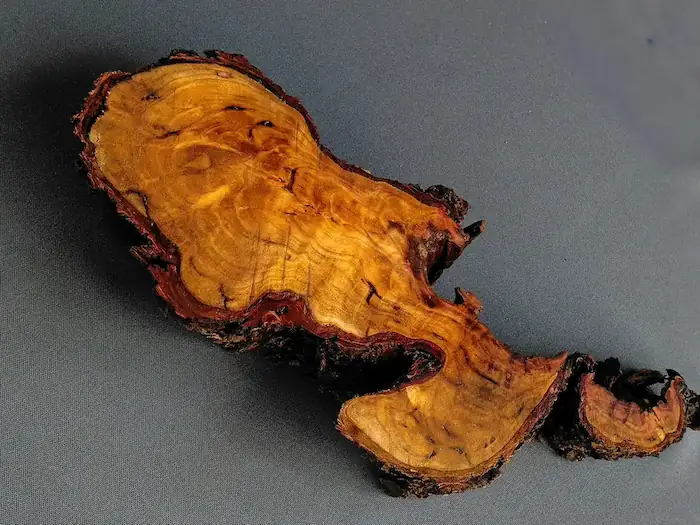
Live edge wood slab prices in South Africa range from around R37 for a small documented cookie to R1,350 and beyond for larger figured specimens — but the price alone tells you almost nothing. What drives the cost is species, size, seasoning method, moisture content, and whether the seller can actually tell you where the wood came from. Here is what to look for before you buy.
What determines the price of a live edge slab?
Several factors combine to set an honest price for live edge timber in South Africa.
Species and origin. Urban salvaged hardwoods — plum, stinkwood, wild fig, and other species removed from Gauteng suburbs — carry different working properties and grain character than plantation softwoods. Species affects density, stability, and how the wood responds to resin, finishing, and joinery. An urban salvaged plum burl produces grain complexity that plantation pine cannot replicate.
Dimensions and form. A small cookie from a branch section and a wide slab from a trunk are cut from fundamentally different parts of the tree. Width, length, and thickness all affect yield and cutting complexity. Cookies, fork sections, slabs, and boards each come from different cuts and represent different amounts of the original material.
Moisture content and seasoning method. This is where most price comparisons fall apart. Field seasoned timber — wood that has been allowed to dry slowly over months, stored flat on stickers, and verified at 8–12% MC before listing — behaves completely differently to fresh-cut material. BurlBlade specimens are sourced from urban trees that had already died naturally before removal, milled, field rested, and stored inside on stickers. Nothing is listed above 12% MC. That process takes time and that time has a cost.
Provenance documentation. A slab with a verified harvest date, origin suburb, species confirmation, and documented moisture content is a fundamentally different product to anonymous timber. Documentation is not a marketing exercise — it is the difference between knowing what you are working with and guessing.
What is a fair price range in South Africa?
Small live edge cookies and offcuts from urban salvaged hardwoods start from around R37 to R350 for documented specimens in good condition. Mid-range figured slabs — wide enough for a shelf, small table, or statement piece — typically fall between R400 and R1,500 depending on species, width, and form. Large slabs wide enough for a full river table or dining surface start at R3,000 to R5,000 from specialist suppliers and can reach R15,000 and above at boutique mills for exceptional pieces.
The wide range exists because “live edge slab” describes everything from a thin branch cookie to a 400mm-wide hardwood slab. Before comparing prices, confirm you are comparing the same thing — species, dimensions, moisture content, and cut type.
Why does documentation affect price?
In the South African market, most timber changes hands without any record of where it came from.
At mills, moisture content is sometimes available if you ask — but the general rule appears to be that if it is for sale, it is dry enough. Species identification is usually accurate at professional mills but harvest date, origin location, and chain of custody are rarely recorded.
On Facebook Marketplace the situation is considerably less predictable. Species misidentification is common — meranti listed as a different species, laminated chipboard presented as solid wood, and fresh-cut timber sold without any moisture assessment. For an untrained buyer, this is a genuine gamble.
Large retailers like Leroy Merlin and Timber City offer consistent species identification and reliable structural timber — but origin, harvest date, moisture content, and seasoning method are not part of the transaction.
Urban salvaged timber from a documented source sits in a different category entirely. When a specimen comes with its harvest location, harvest date, species classification, moisture content reading, and cut type recorded, the buyer is not purchasing anonymous wood. They are purchasing a specific, traceable piece of material with a known history. That is what provenance means — and it is why documented timber commands a premium over equivalent undocumented stock.
What to look for when buying a live edge slab in South Africa
Before purchasing any live edge slab, ask the seller these five questions:
- Where was this tree harvested — which suburb or region?
- What is the current moisture content, and how was it measured?
- When was the tree felled and how has the timber been stored since?
- Is the species confirmed, or is it an estimate?
- Is any documentation available — harvest record, chain of custody, or provenance certificate?
A supplier who cannot answer these questions is not necessarily selling inferior timber — but you are taking on the risk of that uncertainty yourself. A supplier who can answer all five is telling you something meaningful about how they work.
Common questions about live edge wood slab prices in South Africa
Where can I buy live edge wood slabs in Gauteng?
BurlBlade offers urban salvaged live edge specimens sourced and documented in Sunnyridge, Germiston, Gauteng. Each specimen is listed with verified moisture content between 8–12%, individual photography, and a provenance record linking it to its harvest origin. Specimens are available through the online archive at burlblade.co.za and ship across South Africa via PUDO locker, courier, or freight depending on size.
What moisture content should live edge wood be before working or casting?
For general woodworking and joinery, live edge timber should be at equilibrium moisture content for your workshop environment — typically 10–12% in Gauteng’s inland climate. For epoxy resin casting, the target is tighter: 8–10% MC measured at multiple points across the slab, not a single centre reading. BurlBlade specimens are field seasoned and verified at 8–12% MC before listing. Nothing is listed above 12%.
This article was researched and written with the assistance of AI tools. All facts, measurements, moisture content readings, harvest locations, and specimen data referenced are drawn from BurlBlade’s own documented archive and field records. The Provenance Method and all provenance claims represent real processes applied to real specimens.
For documented urban salvaged specimens currently available in Gauteng, the live edge wood slabs for sale in South Africa archive covers both PB2601 plum wood slabs and ground stump root timber specimens — each listed with verified MC, harvest origin, and individual photography.
For technical reference on timber species properties and working characteristics, The Wood Database provides comprehensive information on density, stability, and resin compatibility across species.